
A Human Resource Information System, commonly known as an HRIS, is the software backbone that organizations use to manage the entire lifecycle of their workforce. It brings together the recruitment of new talent, the maintenance of employee records, payroll processing, leave and attendance tracking, performance management, and workforce reporting into one coherent digital environment. In earlier decades, these functions lived in separate spreadsheets, paper files, and disconnected applications, forcing HR teams to re-enter the same information multiple times and making it almost impossible to get a single, trustworthy view of the workforce at any given moment. The modern HRIS changes that. It is designed as a single source of truth, a central system of record from which every other HR-related tool draws its data and to which every HR-related transaction ultimately returns.
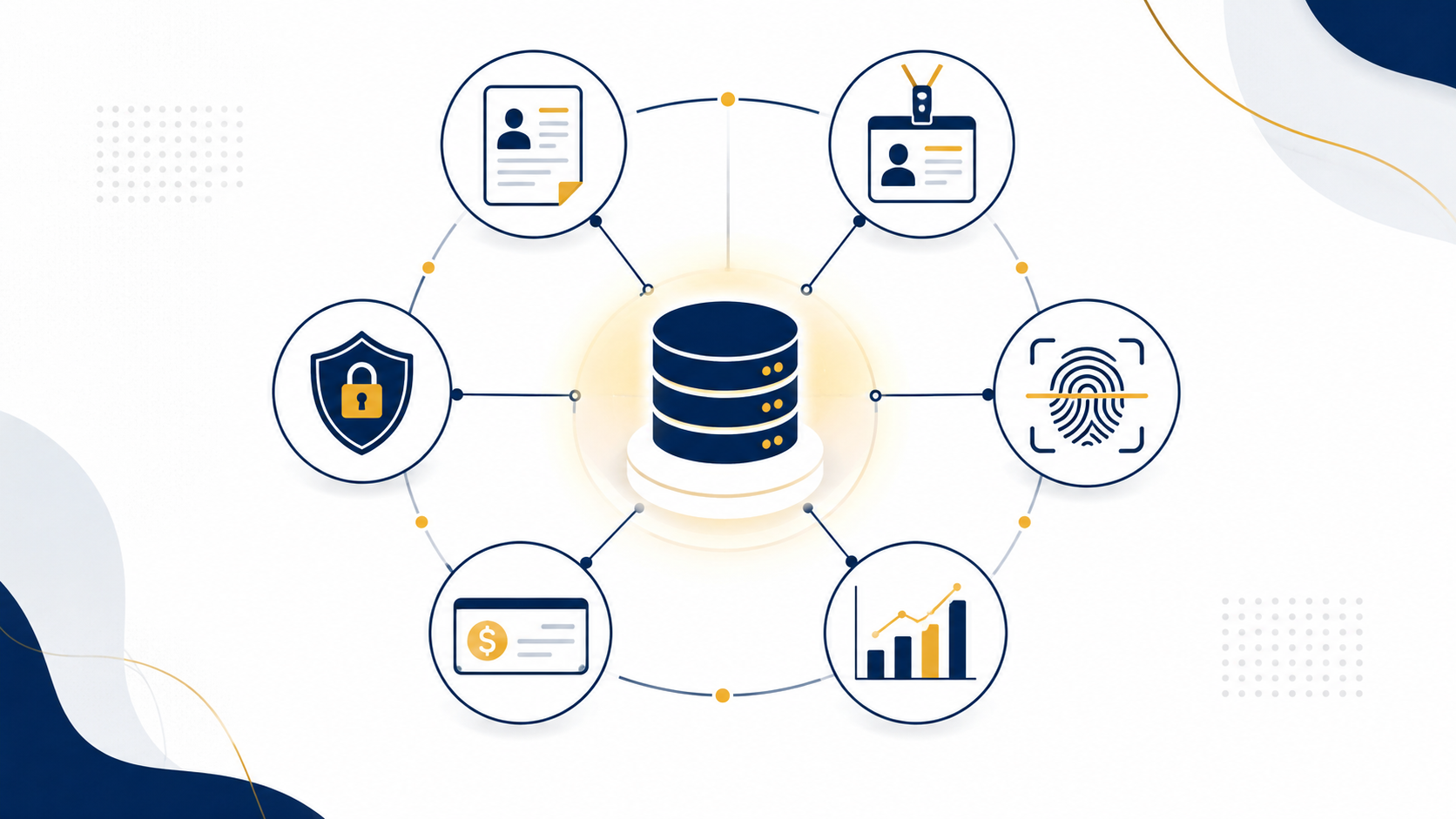
What makes today's HRIS genuinely powerful is not any single module working in isolation, but the way several purpose-built components are woven together into one continuous data flow. A recruitment portal brings candidates into the organization. A core HR and payroll engine manages them once they are employees. An employee self-service portal gives them direct access to their own information. Analytics tools such as Power BI turn all of that activity into insight for leadership. And underneath all of it, integrations with biometric devices, identity and security systems, banking platforms, and communication channels make sure that data moves automatically, accurately, and safely between systems. This article explores each of these pieces in turn, and then examines how they combine to create a seamless HR technology ecosystem.
1. The Core HR and Payroll Engine: The System of Record
At the center of any well-designed HRIS sits a core HR and payroll engine. This is the system where organizational structure is defined, where establishment and job positions are managed, and where every employee's master record lives, including personal details, employment history, qualifications, contract terms, and reporting lines. It is also where the transactional heart of HR beats: recruitment requisitions and job adverts originate here, personnel changes are captured here, payroll periods are processed here, leave requests are approved here, disciplinary cases are tracked here, and exits and separations are finalized here.
Because this engine functions as the authoritative system of record, every other tool in the HRIS ecosystem is built to read from it and write back to it, rather than maintaining its own separate copy of employee data. This single detail is what prevents the classic problem of duplicate, conflicting records scattered across multiple systems. When a new employee joins, their record is created once in the core system, and that same record instantly becomes visible to the self-service portal, feeds the payroll run, and populates the workforce dashboards, without anyone re-typing a single field.
A strong core HR and payroll engine also enforces the internal controls that organizations, particularly regulated ones such as banks, insurers, and pension providers, are required to maintain. Maker-checker workflows ensure that no single individual can both initiate and approve a sensitive transaction, such as a salary adjustment or a payroll run. Approval hierarchies mirror the organization's actual reporting structure, and every change is time-stamped and attributed to a specific user, creating an audit trail that supports both internal governance and external regulatory review.
2. The Recruitment Portal: Where Talent Acquisition Begins
While the core HR engine manages employees once they are on the payroll, the recruitment portal is the front door through which future employees first encounter the organization. A modern recruitment portal is a public-facing, candidate-oriented web application that extends the reach of talent acquisition beyond internal HR staff to external job seekers and internal applicants alike.
Vacancies that are raised and approved inside the core HR system are published automatically to the recruitment portal, where they appear as live job postings. Candidates can register an account, build a structured profile covering their qualifications, work experience, and referees, and apply through a guided, multi-step application process rather than emailing in a CV and hoping for the best. From the candidate's point of view, the experience should feel modern and transparent: they can track exactly where their application stands, whether it has been shortlisted, whether an interview has been scheduled, and, eventually, receive a system-generated offer letter and employment contract without waiting on a manual phone call or email.
The real value of the recruitment portal, however, is not just the candidate experience, it is what happens behind the scenes. Every application submitted through the portal flows directly back into the core system's applicant pipeline. HR staff never have to manually transcribe candidate details from an external job board or a separate applicant tracking tool into the HR system. This eliminates duplicate data entry, reduces the risk of transcription errors, and shortens the time between a vacancy being advertised and a suitable candidate being hired. When the candidate is eventually hired, their profile converts directly into an employee record in the core HR system, carrying their qualifications, documents, and history with them, so recruitment and onboarding become one continuous process rather than two disconnected ones.
3. The Employee Self-Service Portal: Empowering the Workforce
If the recruitment portal is the front door for candidates, the employee self-service portal, often referred to as an ESS portal, is the front door for the existing workforce. It gives every employee, not just HR staff, secure and direct access to their own HR information without needing to submit a paper form or wait for an HR officer to respond to an email.
Through the ESS portal, employees can typically check their leave balances and submit leave applications, download payslips and annual tax certificates, view the status of any grievance or disciplinary case they are involved in, apply for training and development opportunities, review their performance work plans and appraisal outcomes, report health and safety incidents, and raise a variety of operational requests, from equipment requisitions to travel approvals.
The ESS portal is not a stand-alone island of information. It is directly linked to the core HR system, so that leave types, entitlements, payroll records, and case data configured centrally are simply surfaced to employees in real time. Whatever an employee sees in the portal reflects the true, current state of their record in the core system, no more and no less. Equally important, any request an employee submits through the portal, whether it is a leave application or a document request, routes automatically back into the core system for processing, following the same approval workflows and controls that apply to any other HR transaction.
This two-way relationship between the ESS portal and the core HR system is what delivers the real productivity gain. HR teams are freed from a large volume of routine, repetitive administrative work, such as manually looking up leave balances or reprinting payslips, and can redirect their time toward more strategic activities. Employees, in turn, gain a sense of ownership and immediacy over their own HR matters, which tends to improve satisfaction and trust in the HR function.
4. Power BI and Workforce Analytics: Turning Data into Decisions
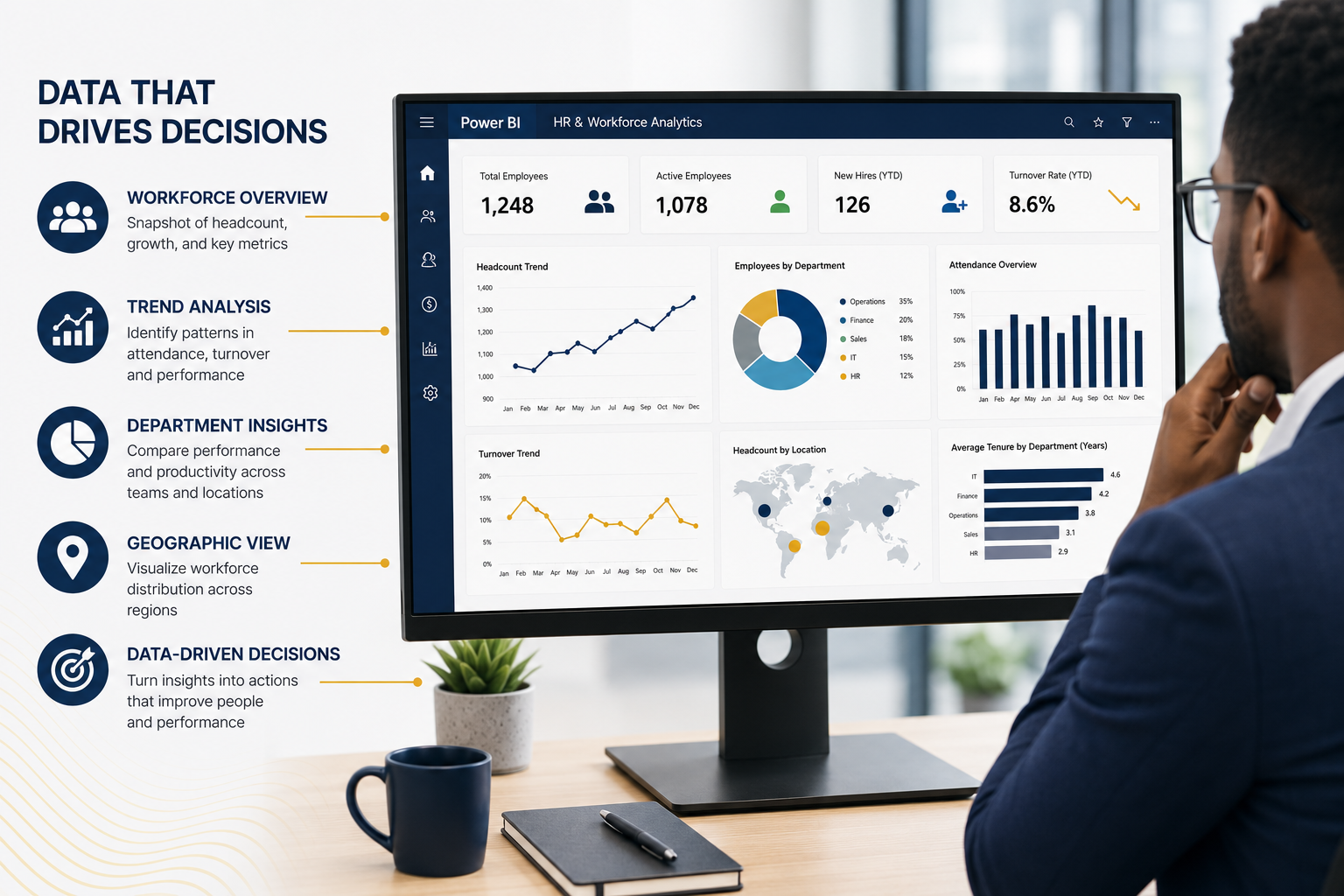
Every recruitment decision, every leave application, every payroll run, and every performance appraisal generates data. On its own, that data is simply a record of what happened. Layered with a business intelligence tool such as Power BI, it becomes something far more valuable: a real-time lens into how the organization's workforce is actually performing and trending.
A well-built analytics layer typically operates at three levels. At the most immediate level, an HR dashboard presents headcount, gender distribution, seniority mix, and departmental distribution at a glance, giving HR leaders and executives a quick pulse check of the organization. At a deeper level, human resource analysis dashboards track turnover rates, workforce movement over time, position-by-gender breakdowns, and headcount trends by business unit, helping leadership understand not just where the organization stands today but where it is heading. At a third level, payroll analytics track payroll cost trends, allowance composition, departmental payroll comparisons, and variance monitoring, which is particularly important for spotting anomalies, such as an unexplained spike in overtime costs or an unusual allowance pattern in a specific department, before they become larger financial or compliance problems.
The critical design decision here is that these dashboards should draw their data live from the core HR system, rather than from static spreadsheet exports that are exported once a month and quickly become outdated. When analytics tools connect directly to the operational HR data, leadership gains continuous, up-to-date visibility, and can use that visibility to support workforce planning, budget forecasting, regulatory compliance reporting, and early detection of irregularities, all without waiting for someone in HR to manually compile a report.
5. Biometric Systems: Anchoring Attendance to Reality
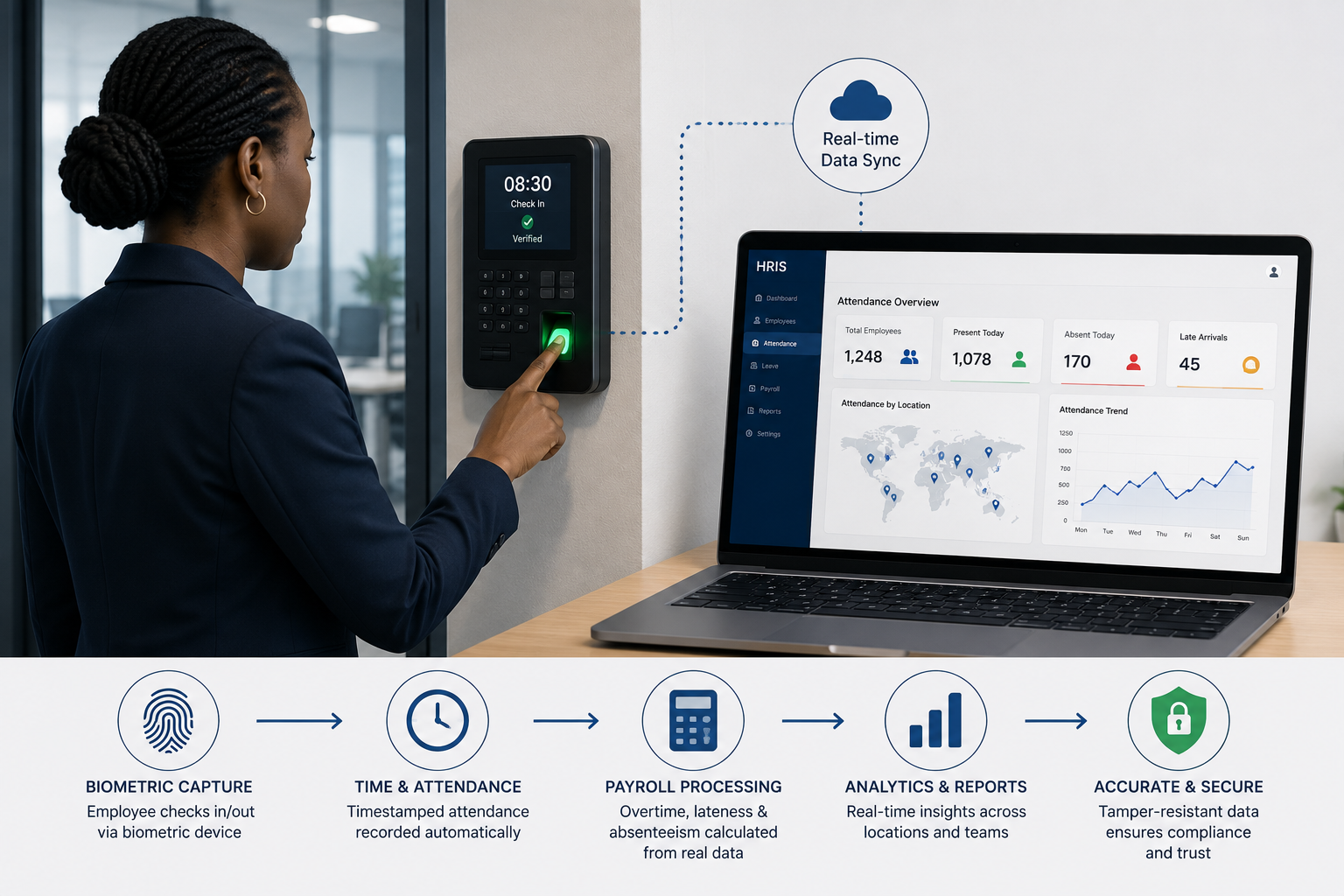
Recruitment portals, self-service portals, and analytics dashboards all depend on accurate underlying data, and one of the most important sources of accurate, tamper-resistant data in any HRIS is the biometric attendance system. Fingerprint scanners, facial recognition terminals, or card-based time clocks capture the moment an employee physically checks in or out of a location, and that transaction, together with the device name and location, feeds directly into the time and attendance module of the core HR system.
This integration matters because it replaces manual or self-reported attendance, which is vulnerable to error and manipulation, with a verifiable physical record. Once attendance transactions are captured automatically, they flow directly into payroll processing, so that overtime, lateness, absenteeism, and shift patterns are calculated from real, timestamped events rather than from a supervisor's memory or a handwritten register at the end of the month. For organizations with multiple branches or sites, biometric integration also means that headquarters can see attendance patterns across every location in near real time, rather than waiting for manual attendance sheets to be collected and consolidated.
Biometric integration is a good example of a broader principle that runs through the entire HRIS: data should be captured once, at its natural source, and then allowed to flow automatically to every system that needs it, rather than being re-entered by hand at each stage.
6. Security, Authentication, and Access Control
An HRIS holds some of the most sensitive information an organization possesses: salaries, national identification numbers, banking details, medical information, disciplinary records, and performance evaluations. Because of this, security cannot be treated as an add-on feature; it has to be built into the foundation of the system.
Role-based access control is the starting point. Every user, whether an HR officer, a line manager, a payroll administrator, or a regular employee, is assigned a security role that determines precisely which data and which functions they can see and act on. A payroll officer who can initiate a salary change, for instance, should typically not also be able to approve that same change; this separation of duties, often called maker-checker control, is a standard safeguard against fraud and error in any system that touches money.
Authentication and identity management add a further layer of protection. Many organizations now integrate their HRIS with a centralized identity provider, such as an Active Directory or a similar directory service, so that employees log in using the same corporate credentials they use elsewhere, rather than maintaining a separate username and password just for HR. Single sign-on, supported through modern authentication protocols, allows employees to move between the core HR system, the self-service portal, and other connected tools without repeatedly logging in. Multi-factor authentication, whether through a one-time password, an authenticator application, or adaptive risk-based checks, adds a critical second layer of verification, which is particularly important for anyone with access to payroll or personal data.
Automated user lifecycle management is another security benefit worth highlighting. When an employee's exit is processed in the core HR system, that event should automatically trigger the disabling of their system accounts, rather than relying on someone remembering to manually revoke access days or weeks later. This closes a common and often overlooked security gap.
Finally, every meaningful action in the system, whether it is a record being created, updated, approved, or deleted, should be captured in an audit trail that records who did what and when. This is not simply a technical nicety; for regulated organizations it is often a legal requirement, and it is the mechanism that allows an internal or external audit to reconstruct exactly what happened to any given record, at any point in time.
7. Integration and Interoperability: The Glue That Holds It Together
None of the components described so far are useful in isolation. Their value comes from being connected, and that connection is made possible through modern integration technology. Contemporary HRIS platforms typically expose their data and functions through application programming interfaces, commonly referred to as APIs, which allow other systems to securely read from and write to the HR system in real time, using standard, well-documented formats.
In practice, this means an HRIS can be connected to a wide range of external systems beyond the recruitment portal, self-service portal, and analytics layer already discussed. It can be linked to core banking or payment platforms, so that payroll files are transmitted directly for salary disbursement rather than being manually uploaded. It can be linked to finance and general ledger systems, so payroll costs post automatically into the organization's books without a separate manual journal entry. It can be linked to communication channels such as email and SMS gateways, so that employees automatically receive notifications when a leave request is approved, a payslip is available, or an interview has been scheduled. It can also be linked to security monitoring tools, so that audit logs and access anomalies feed into the organization's broader security operations rather than sitting isolated inside HR.
Good integration practice also requires that all of these connections be logged, monitored, and reconciled. When data moves automatically between systems, an organization needs the ability to detect a failed or partial transfer quickly, whether that is a biometric device that stopped reporting attendance for a branch, or a payroll file that did not fully reach the bank. Exception reporting and reconciliation processes are what allow an organization to trust automation rather than fear it.
8. How the Components Work Together: A Single, Continuous Data Flow
It is worth pausing to trace a single employee's journey through a fully integrated HRIS, because it illustrates how these separate-sounding components actually behave as one connected system rather than a collection of disconnected tools.
A vacancy is first raised and approved within the core HR system. It is published automatically to the recruitment portal, where candidates apply, are shortlisted, interviewed, and eventually selected. The successful candidate's profile converts directly into a new employee record in the core system, carrying across their qualifications and documents without any manual re-keying. From day one, that employee begins checking in and out through a biometric device, and those attendance transactions flow automatically into the time and attendance module, which in turn feeds directly into that month's payroll run. Throughout their employment, the employee manages their own leave applications, views their payslips, and tracks performance appraisals through the self-service portal, with every request routing back into the core system for processing under the same approval controls that apply to any other HR transaction.
Meanwhile, every one of these events, the hire, the attendance record, the payroll transaction, the leave approval, the performance rating, is captured once in the core system and then reflected automatically in the analytics layer, where leadership can see, in near real time, how headcount, turnover, attendance patterns, and payroll costs are trending across the organization. Security and authentication wrap around every one of these steps, from the moment the candidate first registers on the recruitment portal, through to the day the employee eventually exits the organization and their system access is automatically disabled.
This is the essence of a seamless HRIS: not four or five separate products that happen to sit near each other, but a single continuous data flow, anchored around one authoritative system of record, in which recruitment, personnel management, payroll, attendance, performance, self-service, analytics, and security all reference the same underlying truth.
9. Why Seamless Integration Matters in Practice
Organizations that invest in a genuinely integrated HRIS, rather than a patchwork of disconnected tools, tend to see benefits across several dimensions.
- Accuracy: When data is captured once at its source and shared automatically, the risk of conflicting records across different systems is dramatically reduced.
- Efficiency: HR teams spend far less time on repetitive manual data entry and can redirect that time toward more valuable, strategic work.
- Transparency: Employees and candidates gain real-time visibility into their own information, reducing the volume of routine queries directed at HR staff.
- Compliance and governance: Role-based access, maker-checker controls, and comprehensive audit trails make it far easier to satisfy internal governance requirements and external regulatory obligations.
- Better decisions: Real-time analytics give leadership continuous visibility into workforce and payroll trends, supporting proactive planning rather than reactive firefighting.
- Security: Centralized identity management, multi-factor authentication, and automated account lifecycle management close common security gaps that arise when systems are managed separately.
The reverse is equally instructive. Where HR systems remain fragmented, with recruitment tracked in one spreadsheet, leave managed on paper, attendance recorded on a separate biometric system that nobody reconciles with payroll, and reporting compiled manually once a quarter, organizations tend to experience duplicated effort, inconsistent records, delayed decision-making, and, in regulated sectors, real compliance exposure.
10. Implementation Considerations
Bringing these components together successfully is not purely a technology exercise; it also depends on disciplined planning and change management. Data migration from legacy systems needs to be approached methodically, typically involving a clear mapping of existing data fields to the new system, a thorough data quality assessment and cleansing exercise, a pilot migration to validate the approach, a full migration with reconciliation against the old system's figures, and formal sign-off before the new system goes live for real transactions.
Implementation should also proceed through clearly governed phases, moving from initial planning and requirements confirmation, through system configuration and data migration, to integration build-out with banking, biometric, and communication systems, followed by structured user acceptance testing before go-live. Throughout this process, training is essential at two levels: general end-user training so that employees and managers are comfortable using the self-service and recruitment portals, and deeper administrator training so that internal system administrators can configure, troubleshoot, and maintain the platform without being permanently dependent on external vendors.
Finally, organizations should plan for business continuity from the outset, including regular automated backups, a documented disaster recovery plan, and clearly defined recovery time and recovery point objectives, so that a technical failure never puts payroll or core HR operations at serious risk.
Conclusion
A Human Resource Information System is at its most valuable not when it is judged module by module, but when it is understood as a single, connected ecosystem. A core HR and payroll engine anchors the entire system as the authoritative record. A recruitment portal brings new talent in through a modern, transparent process that feeds directly into that record. An employee self-service portal gives the workforce direct, real-time access to their own information while routing every request back through proper controls. Power BI and similar analytics tools convert the resulting data into live, decision-ready insight for leadership. And running underneath all of it, biometric attendance devices, robust security and authentication frameworks, and well-governed system integrations ensure that data moves automatically, accurately, and safely between every part of the system.
Organizations that build their HRIS around this principle, one authoritative source of truth, surrounded by well-integrated recruitment, self-service, analytics, and security layers, position themselves not just to manage HR administration more efficiently, but to make faster, better-informed decisions about the people who ultimately drive the organization's success.
At FanisiTech, we don't just implement HR systems, we build connected ecosystems that bring recruitment, employee self-service, payroll, analytics, and security together into one seamless experience for your organization. Our team has the technical depth and hands-on delivery experience to take your HR function from fragmented and manual to integrated and intelligent. If you're ready to give your workforce a modern, unified HRIS, and your leadership the real-time insight to match, reach out to FanisiTech today to start the conversation.
Office Number: 718, 7th Floor, KU PLAZA, Haile Selassie Avenue, Nairobi CBD
Postal Address: P.O. Box 25063-00100, Nairobi, Kenya
Phone: +254 743 313 103
E-mail: info@fanisitech.com
Website: www.fanisitech.com
Latest Comments
No comments yet for this post. Be the first to comment
Comment on the blog "The Human Resource Information System: Building a Seamless, …"